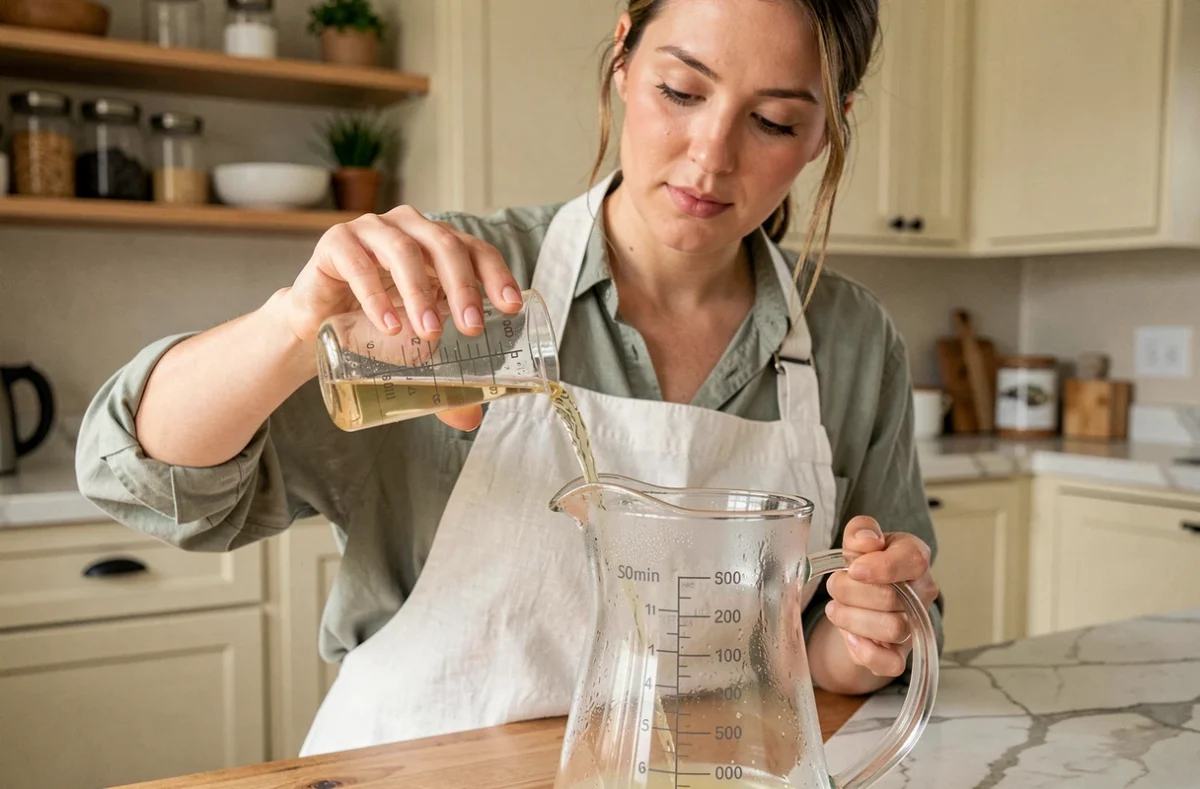
In cooking, most French recipes express liquid volumes in milliliters or centiliters, while some utensils display graduations in liters. Converting 200 ml to liters means dividing by 1,000, which gives 0.2 liters. The calculation is straightforward, but the physical measurement with a measuring cup introduces sources of error that the simple mathematical ratio does not resolve.
Graduation of the measuring cup: what affects the reliability of the measurement
A measuring cup has markings engraved or printed on its wall. Before measuring anything, it is essential to identify the unit indicated. Some models display milliliters (mL), others centiliters (cL), and some even fluid ounces (fl oz) or cups.
Confusing a graduation in grams with a graduation in milliliters is common because for pure water, the two values coincide. For any other liquid (oil, whole milk, syrup), volume and mass are not interchangeable. A measuring cup measures a volume, not a weight.
The readability of the graduations is as important as their presence. A marking faded by successive washes or printed in a low-contrast color makes reading approximate. If the line corresponding to 200 mL is no longer visible, it is better to change utensils than to guess. Checking that the indication “mL” and the desired marking remain clear is a reflex to adopt before each use.
To measure 200 ml to liters with a measuring cup, simply locate the 200 mL mark (or 0.2 L if the container is graduated in liters) and fill to that level.
Reading a measuring cup without distorting the measurement: the meniscus technique
Pouring a liquid into a measuring cup is not enough. The way you read the level determines the accuracy of the result.
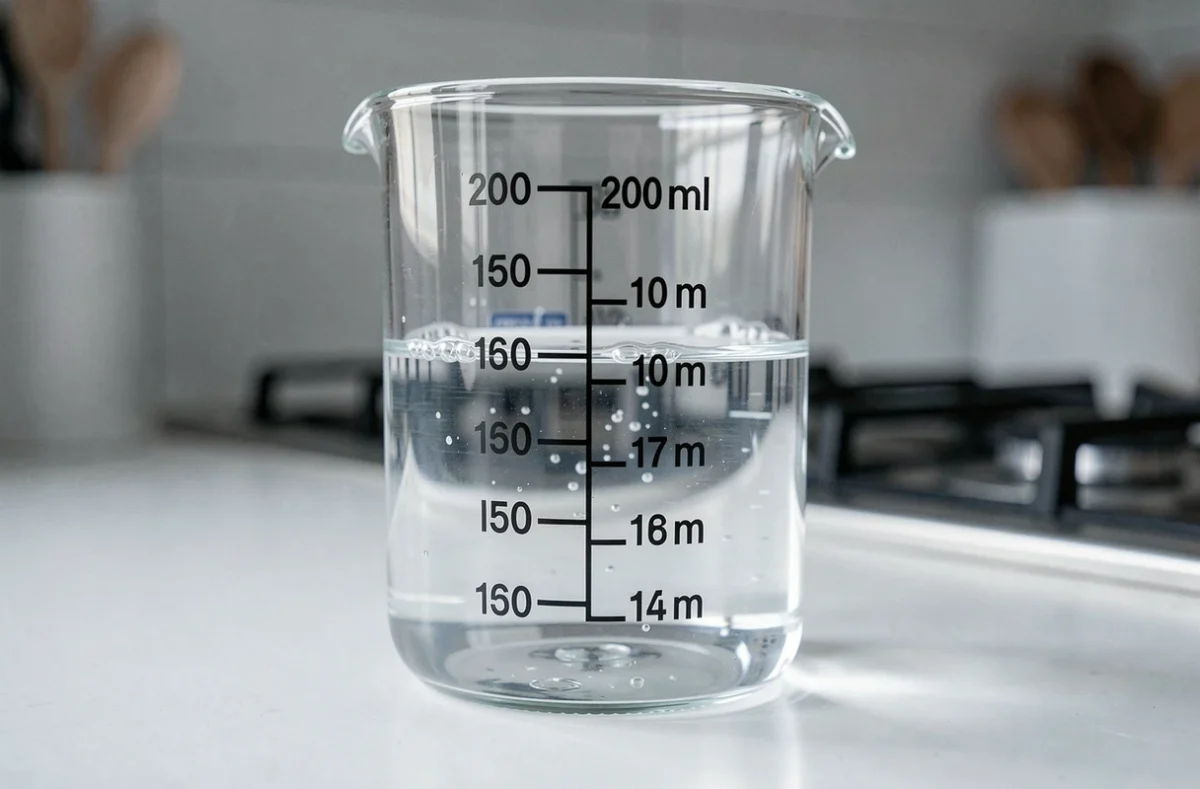
Place the measuring cup on a flat surface and read at eye level. If you look from above, the angle of view shifts the apparent marking upwards, and you pour too much. From below, it is the opposite.
With water, the liquid forms a slight dip in the center, called a meniscus. The correct reading is made at the lowest point of this curve, not on the edges that rise against the wall. For an opaque liquid like milk or a dark broth, the meniscus is less visible, but the principle remains the same: align your eye with the targeted graduation.
Case of measuring cups read from above
Some recent models have slanted graduations readable from the top of the container. With this type of cup, there is no need to bend down. The downside is that these graduations are often less precise: they allow you to aim for 200 mL, but not to distinguish 195 mL from 205 mL. For most home recipes, this margin remains acceptable.
Conversion of 200 ml to liters: why the formula only covers part of the problem
The division by 1,000 (200 ÷ 1,000 = 0.2) is exact on paper. In practice, three factors cause the actual amount poured into the preparation to vary.
- The temperature of the liquid slightly alters its volume. A hot liquid takes up a bit more space than a cold liquid for the same mass. In baking, where precision matters more, measuring liquids at room temperature limits this discrepancy.
- Viscosity changes the behavior in the container. A thick syrup adheres to the walls of the measuring cup, and some remains stuck after pouring. The amount transferred is then less than what was measured.
- The act of pouring itself introduces a loss. Pouring too quickly creates splashes, while pouring too slowly leaves more residue on the wall. A steady and smooth pour reduces the gap between the measured and actual amounts.
For a soup or a sauce, these variations have no noticeable consequence. For a pancake batter or a custard, they can alter the final texture.

Measuring 200 ml without a measuring cup: reliable equivalents and limits
When the measuring cup is not available, several common utensils serve as references. Their reliability is not the same.
- A tablespoon contains about 15 mL. Therefore, it takes a little more than 13 tablespoons to reach 200 mL. This method works, but it is slow, and each spoon introduces a small margin of error that adds up.
- A standard coffee cup holds about 100 mL. Two cups filled to the brim give 200 mL. The problem is that the capacity varies depending on the cup: no household cup is a calibrated measuring instrument.
- A classic mustard glass holds about 200 mL. This is the most direct equivalent, provided you use a standard glass and fill it to the brim.
These equivalents help for tolerant recipes (soups, marinades, drinks). For a recipe that requires precision, such as a flan or caramel, they remain approximate.
The option of a kitchen scale
For water, 200 mL corresponds to 200 g. A kitchen scale, even a low-end one, measures grams with greater precision than a cup filled by eye. This correspondence only holds for water and liquids of comparable density. For oil, 200 mL weighs less than 200 g, and for honey, significantly more.
Quick conversion table for common liquids in cooking
| Milliliters (mL) | Centiliters (cL) | Liters (L) | Tablespoons (approximately) |
|---|---|---|---|
| 50 | 5 | 0.05 | 3-4 |
| 100 | 10 | 0.1 | 6-7 |
| 200 | 20 | 0.2 | 13-14 |
| 250 | 25 | 0.25 | 16-17 |
| 500 | 50 | 0.5 | 33-34 |
This table covers the most requested volumes in French recipes. The tablespoon column provides an approximate measure, not an exact value, since the capacity of a tablespoon varies depending on its shape.
Converting 200 ml to liters takes a second of mental calculation. Obtaining exactly 200 mL in a dish requires a readable measuring cup, eye-level reading, and careful pouring. The mathematical conversion is simple, the physical measurement is less so, and it is the latter that determines the result on the plate.